SEO gets you ranked, AEO gets you quoted and GEO gets you named in AI-written answers. Here is what each term means, where they overlap and how a SaaS team should plan for all three without tripling the work.
New acronyms arrive faster than budgets. If your team has heard SEO, AEO and GEO in the same week, it is fair to ask whether these are three jobs or one. The honest answer: one foundation, three goals.
What is SEO?
Search engine optimization is the work of ranking your pages in Google and Bing for the searches your buyers make. It covers technical health, content that answers search intent and links from other sites that build authority. Success is measured in rankings, organic traffic and the leads it brings.
What is AEO?
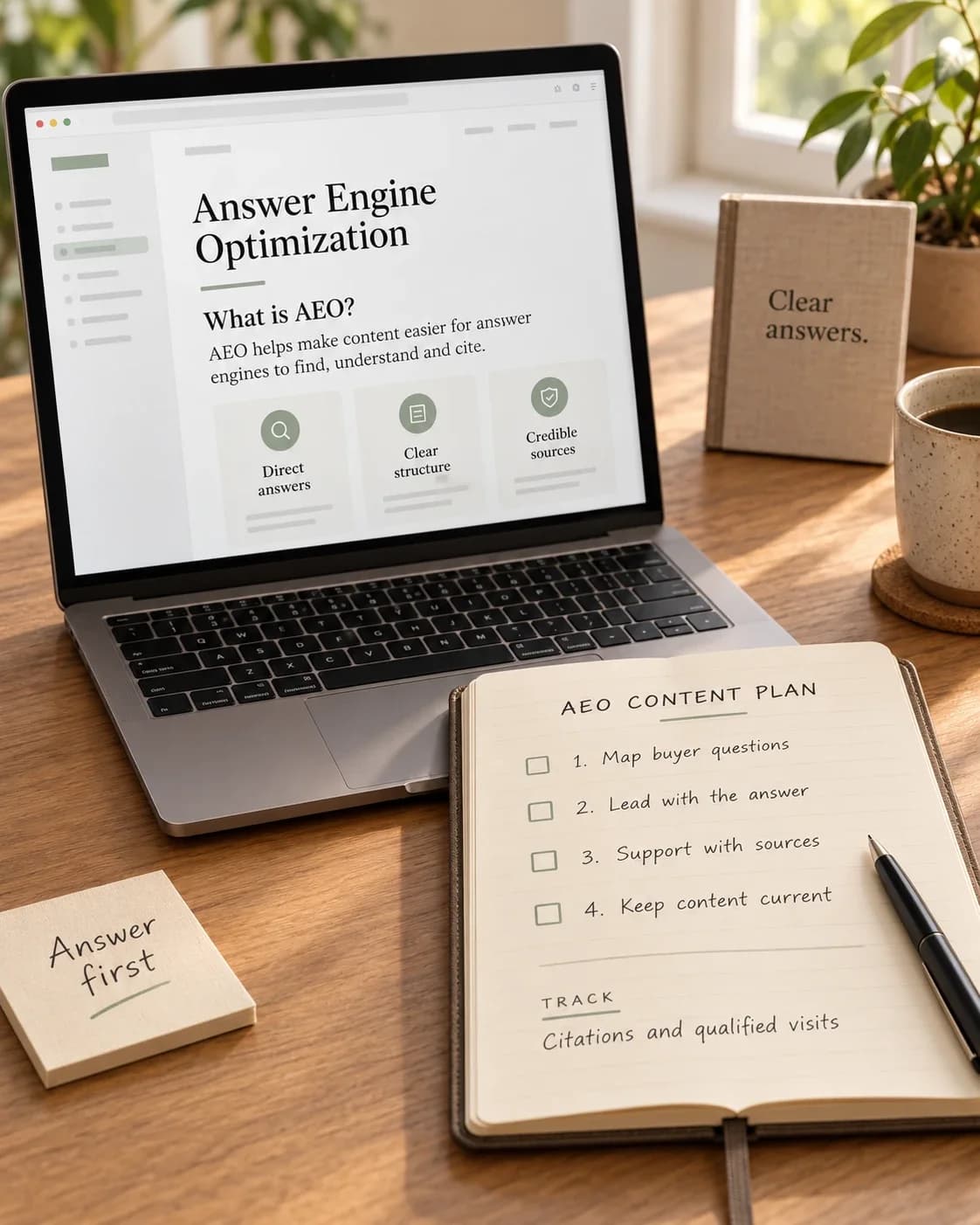
Answer engine optimization is the work of becoming the answer: the page a featured snippet, a voice assistant or an AI tool quotes when someone asks a question. It focuses on clear, direct answers, structured pages and schema markup that make content easy to lift. Our guide to what AEO is covers it in depth.
What is GEO?
Generative engine optimization is the newer name for getting your brand named and cited in answers from generative AI tools such as ChatGPT, Perplexity, Gemini and Google AI Overviews. In practice GEO and AEO describe almost the same work; GEO puts more weight on brand mentions across the web, because AI tools build their answers from many sources.
How they compare
- Goal: SEO wants a high ranking; AEO wants your page quoted as the answer; GEO wants your brand named in AI-written answers.
- Where it shows: SEO in the list of results; AEO in snippets and answer boxes; GEO inside ChatGPT, Perplexity, Gemini and AI Overviews.
- What matters most: SEO needs relevance and authority; AEO needs clear, structured answers; GEO needs consistent brand mentions and trusted sources.
- How to measure: SEO by rankings and organic traffic; AEO by snippets and citations; GEO by how often AI tools name and describe you.
Where they overlap
All three reward the same things: pages that answer real questions well, a fast and well-structured site, and a brand other sites mention and describe consistently. AI tools also lean heavily on pages that already rank, so strong SEO makes AEO and GEO easier, not redundant.
- Fix the technical basics: crawling, indexing, speed, and schema markup for your organization, services, articles and FAQs.
- Write answer-first pages: put the direct answer in the first two sentences, then the detail.
- Describe your brand the same way everywhere, from your site to LinkedIn, review sites and directories. This is entity SEO.
- Earn mentions in the comparisons, reviews and publications that AI tools cite in your category.
- Measure all three: rankings and traffic in Search Console, and a fixed set of buyer questions asked in AI tools every month.
Want to know where you stand? Our free growth audit checks your rankings and how AI tools describe you, and lists the five changes we would make first. See how our answer engine optimization service works for SaaS teams.

One page, three jobs: a worked example
Take a SaaS company that sells expense software and wants to be found for "how to automate expense reports". Here is how one page can serve all three disciplines at once.
- SEO: a clear title tag, a URL with the topic in it, internal links from related pages and a few relevant backlinks.
- AEO: a 50 word answer at the top, a numbered list of steps that can win a featured snippet, and an FAQ that matches People Also Ask.
- GEO: specific, quotable facts about how the product does it, consistent with the brand's descriptions elsewhere, so AI tools can cite it in a longer answer.
Nothing here conflicts. The same habits, clear structure and specific answers, serve all three. That is why we treat them as one programme in our AEO service and SEO service.
Where to spend first
If your site has technical problems or isn't indexed properly, fix SEO first: no AI tool can cite a page it can't read. If you already rank but aren't named in AI answers, put more effort into AEO and GEO: answer-first rewrites, entity SEO and mentions on trusted sites. Our AI search optimization guide has a 90-day plan.
Quick quiz
SEO, AEO or GEO?
Match each task to the discipline it serves most directly.
1. Fixing pages that Google can't index
2. Writing a 50 word answer at the top of a page to win a featured snippet
3. Getting your product named in a long ChatGPT answer about the best tools in your category
0 of 3 answered
What people mean by "GEO SEO"
"GEO SEO" is searched with two different meanings, so it helps to separate them. In marketing teams today it usually means generative engine optimization done as part of SEO: making your pages and brand easy for AI tools to find, understand and cite. Older guides use "geo SEO" to mean geographic or local SEO: ranking in a city or region, with Google Business Profiles and local pages. This guide is about the first meaning. If you need the second, look for local SEO; the two share technical basics but little else.
Treating GEO as part of SEO, rather than a separate project, is the right instinct. The work happens on the same pages, uses the same technical foundation and is measured in the same tools, with a few additions.
How generative engines choose their sources
You don't need to know how each model works internally, but the broad mechanics explain most GEO advice.
- The question gets expanded. An assistant often turns one question into several searches behind the scenes (sometimes called query fan-out), for example "best expense software for startups", "expense software pricing" and "expense software reviews".
- Pages are retrieved. Those searches run against a web index: Bing for some tools, Google's own index for AI Overviews and AI Mode, and each company's own crawler index. Pages that can't be crawled or indexed drop out here. See AI crawlers explained.
- Passages are selected. The model reads parts of the retrieved pages and picks passages that answer the question clearly. Vague, padded or JavaScript-only content loses at this stage.
- An answer is written from agreement. Where several sources say the same thing, the model is more confident. Brands described consistently on many trusted sites get named; brands described differently everywhere get skipped or described wrongly.
Each step suggests a job: be indexable, cover the fan-out questions, write passages that stand on their own, and make the web agree about who you are.
A GEO SEO checklist for SaaS
- Crawl access: robots.txt and your firewall allow the search crawlers from OpenAI, Anthropic, Perplexity, Google and Bing.
- Server-rendered content: product, pricing and FAQ copy appears in the HTML, not only after JavaScript runs.
- Answer-first sections: each important heading is followed by a two or three sentence answer that makes sense if quoted alone.
- Fan-out coverage: for each core buyer question, you have pages for the follow-ups too: pricing, comparisons, integrations, alternatives, use cases.
- Specific facts: numbers, names, steps and dates instead of adjectives. "Connects to Xero and QuickBooks" beats "seamless integrations".
- Consistent entity data: the same one-line description of your company on your site, LinkedIn, G2 or Capterra, Crunchbase and partner pages.
- Structured data: Organization, Product or Service, Article, FAQ and breadcrumb schema markup that matches what the page says.
- Third-party mentions: reviews, comparison articles, podcasts and community threads that describe you accurately.
- Freshness: clear updated dates, and real updates when your product or pricing changes.
- Authorship: named authors with relevant experience, especially for advice content.
How to measure GEO
Rankings don't tell you whether AI tools name you. Add these to your monthly SEO report.
- A fixed prompt set: 20 to 50 questions your buyers really ask, run each month in ChatGPT, Perplexity, Gemini and Google's AI features.
- Mention rate: in what share of answers your brand is named.
- Share of voice: how often you're named compared with your main competitors. See AI share of voice.
- Citation share: how often your own pages are linked as a source, versus third-party pages about you.
- Accuracy: whether the description, pricing and positioning in the answers are right.
- AI referrals: sessions from chatgpt.com, perplexity.ai and similar sources in your analytics, and the leads they bring.
Our guide to tracking your brand in AI search shows how to set this up in a spreadsheet in an afternoon.
GEO myths worth ignoring
- "SEO is dead, do GEO instead." AI tools rely heavily on search indexes and on pages that already rank. Weak SEO makes GEO harder.
- "Add an llms.txt and you're done." It's a helpful summary file, not a ranking switch. Access, content and mentions still decide citations.
- "Stuff pages with statistics and quotes." Specific, sourced facts help. Invented or padded ones damage trust with readers and models alike.
- "You can buy your way into ChatGPT answers." Organic AI answers can't be bought. Ads in AI tools, where they exist, are labelled and separate. See ChatGPT ads for B2B SaaS.
- "GEO results are instant." Search crawlers can pick up a page within days, but changing how the web describes your brand takes months of steady work.
Frequently asked questions
Almost. Both aim to get your brand into AI-written answers. GEO is the newer, more academic term and puts more weight on mentions across the web; AEO is the name many marketers use and includes featured snippets and voice answers.
Yes. AI tools draw heavily on pages that rank well, and search engines still send most website visits. SEO is the foundation that AEO and GEO build on.
Start with SEO foundations and answer-first content, because they serve all three. Add GEO work, such as review profiles and outreach for mentions, once the core pages are in place.
No. They share most of the same work, so one team with a single plan usually does better than three teams working apart.
GEO SEO usually means generative engine optimization done as part of SEO: making your site and brand easy for AI tools like ChatGPT, Perplexity, Gemini and Google AI Overviews to find, understand and cite. Some older guides use the phrase for geographic or local SEO, which is a different discipline.
No. Local SEO helps a business rank in a particular city or region, mainly through Google Business Profiles and local pages. Generative engine optimization is about being named in AI-written answers, wherever the buyer is.
No. GEO builds on SEO. AI tools retrieve pages from search indexes and lean on sources that already rank, so technical SEO and strong content remain the foundation.
Technical fixes such as unblocking crawlers can show within days or weeks. Changing how AI tools describe your brand depends on content and third-party mentions, and usually takes a few months of steady work.