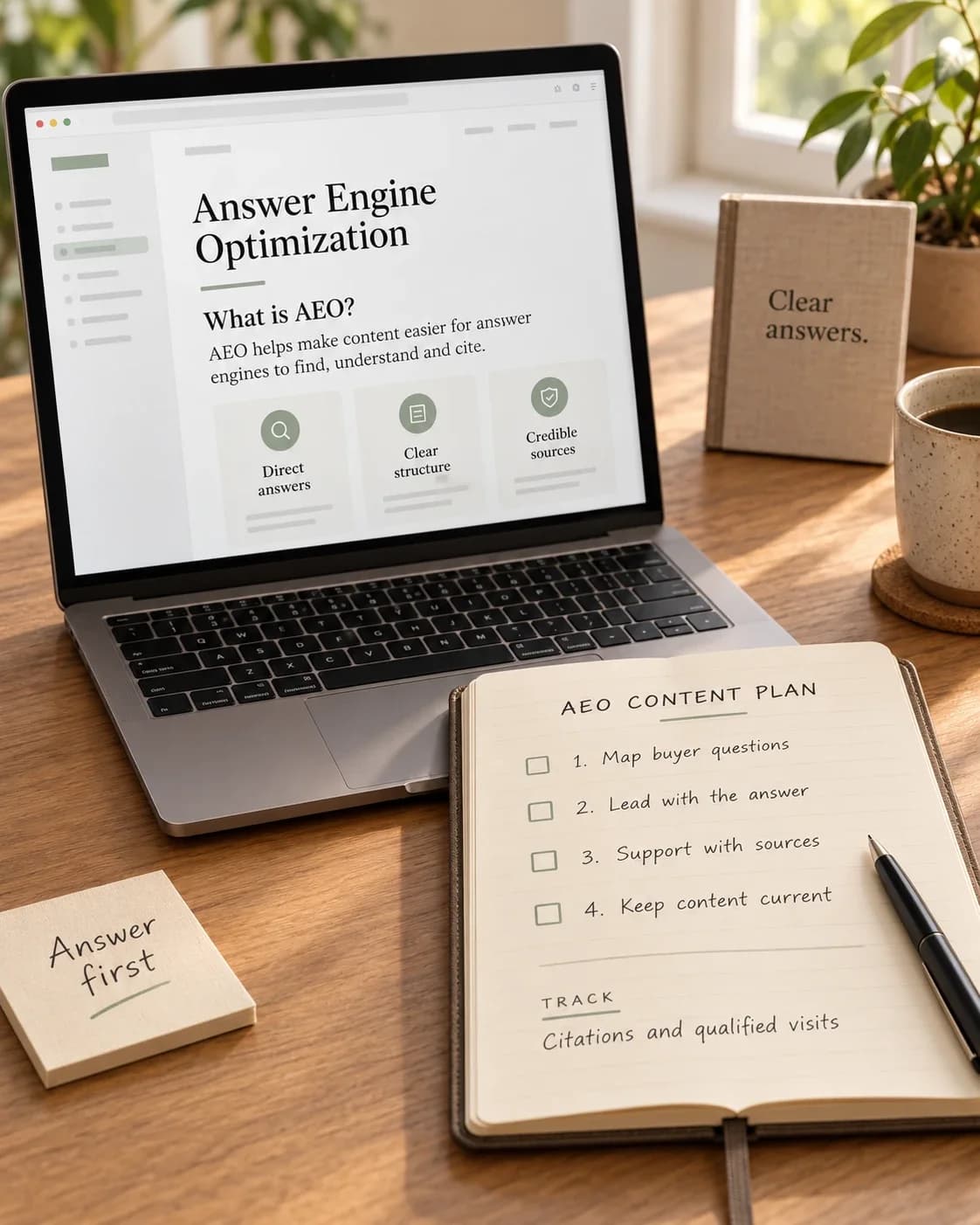
AEO, short for answer engine optimization, is the work of getting your brand named and cited when people ask AI assistants like ChatGPT, Perplexity or Google AI Overviews for an answer. Here is how it works, how it differs from SEO and GEO, and where to start.
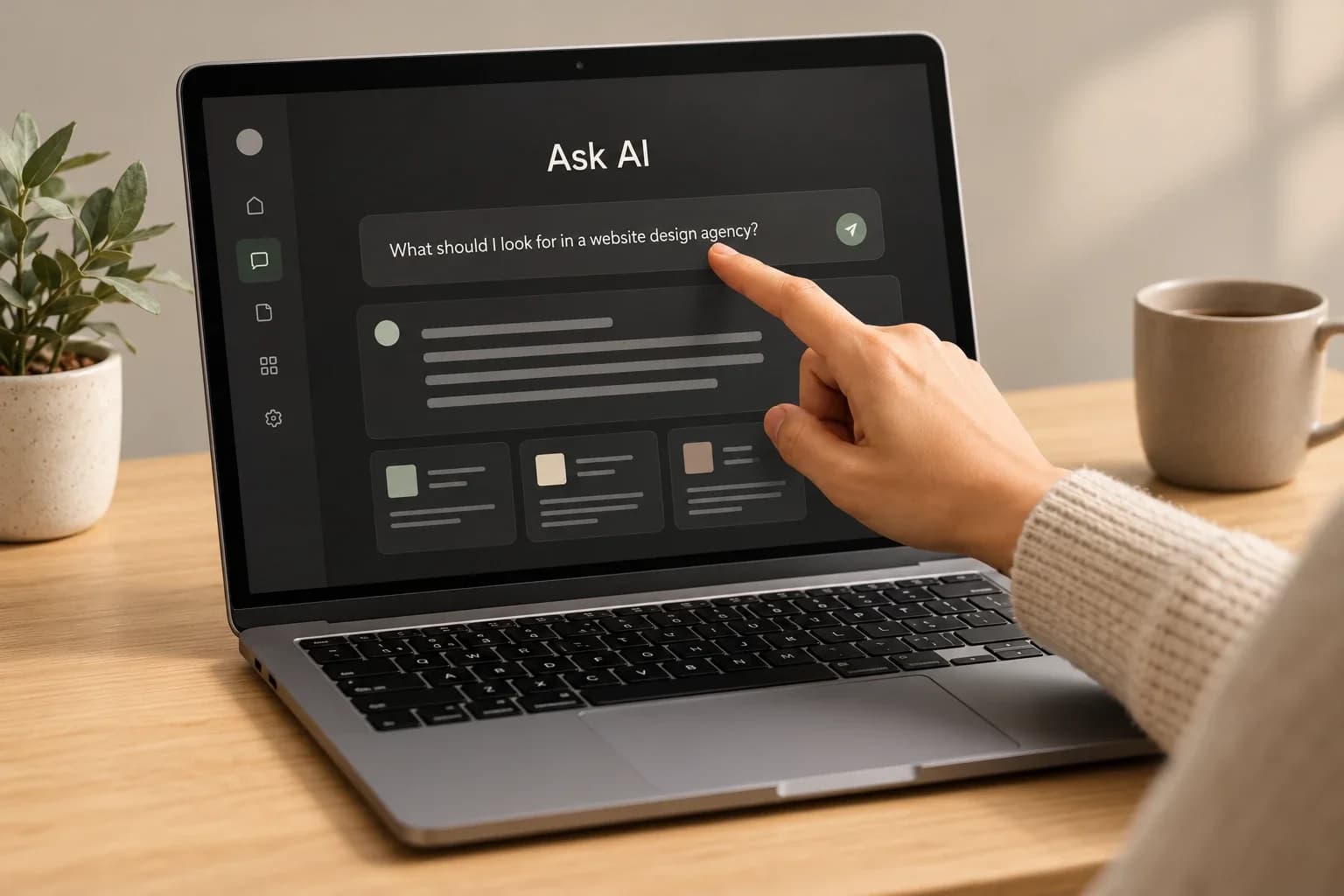
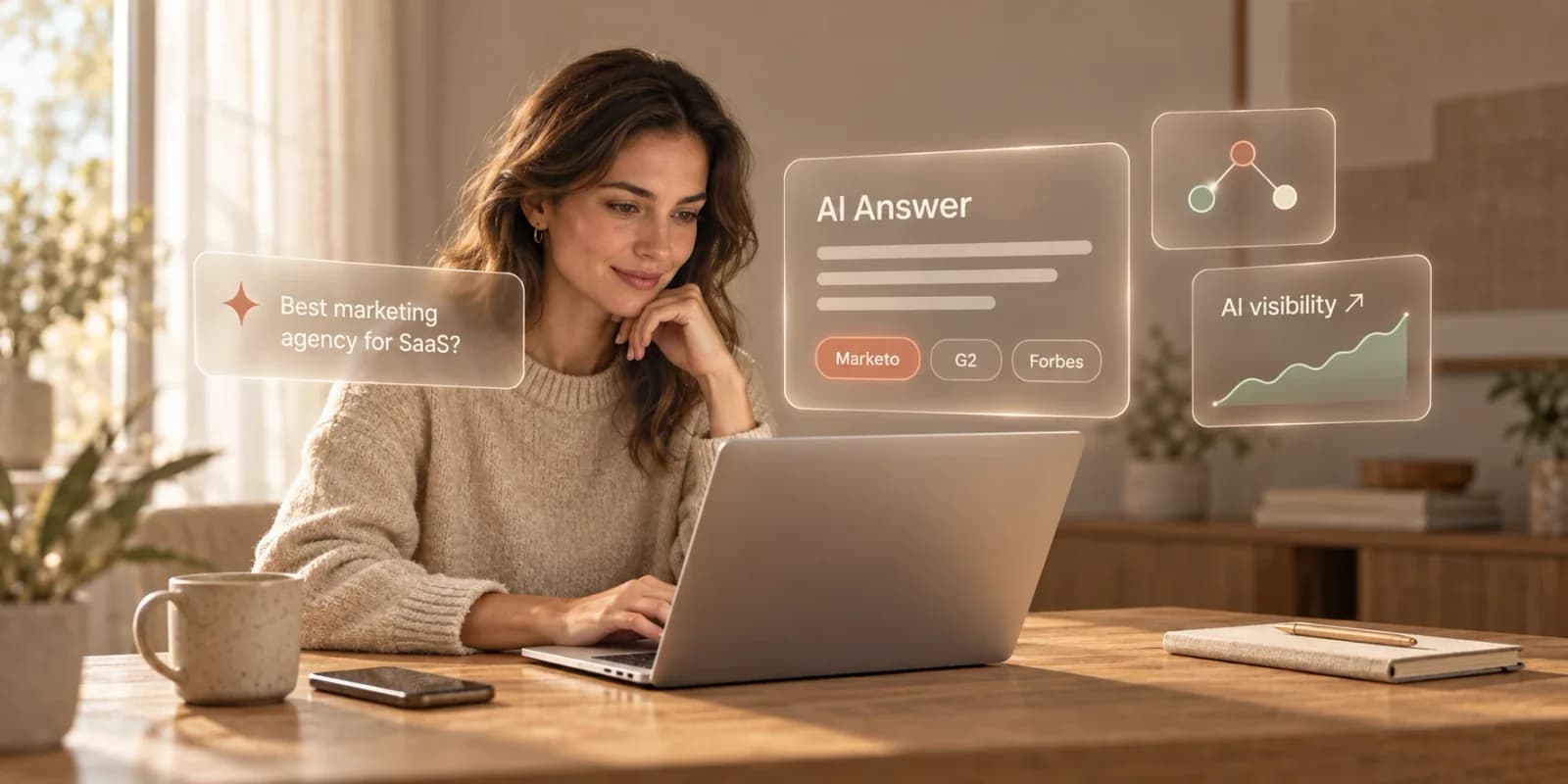
Search has a new front door. Before a buyer types a query into Google, many now ask an AI assistant: which tools should we consider, which agency is good at this, what does a strong setup look like? The assistant replies with a short answer and a handful of names. If yours isn't one of them, you are off the shortlist before your website gets a visit.
This guide explains what AEO is, how it relates to SEO and GEO, how assistants decide what to cite, and a practical plan to improve your brand's AI visibility.
What is AEO?
Answer engine optimization is the practice of structuring your content and your wider online presence so that answer engines can find it, understand it and quote it. An answer engine is any tool that responds to a question with a written answer instead of a list of links: ChatGPT, Perplexity, Claude, Gemini, Microsoft Copilot and the AI Overviews at the top of many Google results.
The goal changes from ranking to being referenced. In classic search, success is a high position on the results page. In AEO, success is your brand appearing inside the answer, described accurately, ideally with a link to your site as the source.
Why AEO matters for SaaS companies
- Buyers research with assistants. Comparing tools, asking for alternatives and checking what a category does are exactly the questions people now put to an AI assistant first.
- Answers shrink the field. A results page shows ten links; an answer usually names a few options. Being one of them matters more than ever.
- Fewer clicks reach your site. When the answer is complete on the page, many people never click through, so the mention itself has to do the work.
- Early movers gain ground. Most SaaS brands haven't started on AI visibility, so clear, consistent work stands out sooner than in crowded search results.
AEO vs SEO: what's the difference?
AEO builds on SEO rather than replacing it. Many assistants pull information from a search index before writing their answer, so pages that are crawlable, fast and well ranked still have an advantage. The differences are in what you optimize for.
- Goal: SEO aims for a high ranking and a click. AEO aims for a mention or citation inside the answer.
- Unit of content: SEO optimizes pages for keywords. AEO optimizes for questions, and for short passages that answer them completely.
- Signals: SEO leans on links and relevance. AEO also depends on how consistently your brand is described across the web and how often trusted sources mention you.
- Measurement: SEO tracks rankings and organic traffic. AEO tracks how often you are mentioned and cited for a set of buyer questions.
What is GEO? AEO, GEO and AI search optimization
You will also see generative engine optimization (GEO) and AI search optimization. GEO comes from a 2023 research paper that studied how to make content more visible in answers written by generative AI. In practice the three terms describe the same goal, being visible in AI-written answers, and most teams use them interchangeably. We use AEO because it puts the focus where buyers are: on the answer.
How AI assistants decide what to cite
No assistant publishes its full ranking rules, but the pattern across tools is consistent. When a question needs current or specific information, the assistant searches, reads a set of sources and writes an answer from them. Content is more likely to be used when it:
- answers the question directly and early, in plain language;
- comes from a source that is trusted for the topic;
- agrees with what other reputable sources say about the brand or subject;
- is easy to read and parse, with clear headings, lists and specific facts;
- is current, with dates and details that are up to date.
For your brand to be recommended, the assistant also has to understand what you are: your name, your category, who you serve and how you differ. That understanding comes from how your brand is described on your own site and everywhere else.
How to get your brand cited in AI answers
1. Find the questions your buyers ask
Write down 20 questions a buyer asks before choosing a product like yours, for example "best project management tool for agencies" or "alternatives to [competitor]". Ask each one in ChatGPT, Perplexity, Gemini, Claude and Google, and record who is named and which sources are cited. This baseline shows where you appear, where competitors appear and which sites the assistants rely on.
2. Write answer-first content
Give every important question a clear answer of 40 to 60 words at the top of the relevant page, then expand with detail, examples and evidence. Product pages, comparison pages, use-case pages and FAQs all benefit. Avoid vague claims; assistants prefer statements they can quote with confidence, such as what your product does, who it is for and what it integrates with.
3. Make your brand unmistakable
Describe your company the same way everywhere: the same name, the same one-line description, the same category. Check your website, LinkedIn, Crunchbase, G2, Capterra and partner listings. Inconsistent descriptions make it harder for an assistant to be sure who you are, so it may leave you out or describe you wrongly.
4. Add structured data
Schema markup labels the facts on a page in a format machines read easily: Organization (with links to your official profiles), Product or SoftwareApplication, FAQPage and Article are the useful starting points. It doesn't guarantee a citation, but it removes guesswork about what your pages say. It is part of the technical work in our SEO service.
5. Earn mentions on sources the assistants trust
Assistants tend to repeat what reputable sources agree on. Reviews on software marketplaces, independent comparison articles, industry publications, podcasts and active community discussions all shape how your brand is described. Digital PR, partner content and customer reviews do more for AEO than anything you publish on your own site alone.
6. Keep your pages crawlable and current
Make sure your key content is in the page's HTML, not hidden behind logins, tabs that need clicks or images of text. Check your robots.txt: search crawlers such as OAI-SearchBot (ChatGPT search) and PerplexityBot need access for your pages to appear as sources in those tools. GPTBot, OpenAI's crawler for model training, is a separate choice. Review important pages every few months and update facts, dates and screenshots.
- Mention rate: how many of your buyer questions name your brand, per assistant.
- Citation rate: how often your site is linked as a source.
- Accuracy: whether the assistant describes your product, pricing and category correctly.
- Share of answer: how often you appear compared with your main competitors.
- Referral traffic: visits from chatgpt.com, perplexity.ai and similar sources in your analytics.
Re-run the same question set monthly and keep dated screenshots. Answers vary from one run to the next, so look at the trend over several months rather than a single result.
Common AEO mistakes
- Stuffing pages with keywords instead of answering the question.
- Gating your most useful content behind forms, where assistants can't read it.
- Describing your company differently on every profile and directory.
- Chasing tricks such as hidden text written for AI tools. It can be treated as spam and isn't a reliable way in.
- Expecting results in a week. AI visibility builds as content, mentions and consistency add up.
Where to start this week
- Write your 20 buyer questions and record today's answers as a baseline.
- Rewrite the opening of your homepage and top product page as a clear, quotable answer.
- Align your company description across your site, LinkedIn and your top three directories.
- Check that robots.txt allows the AI crawlers you want to appear in.
- Pick one trusted source where you are missing, such as a review site or comparison article, and plan how to earn a mention there.
If you would like a second pair of eyes, our free growth audit includes an AI visibility check: we ask the questions your buyers ask and show you where you appear, where competitors appear and the changes we would make first. You can also see how our AEO service works.

AEO for different kinds of SaaS
The basics are the same for everyone, but the questions buyers ask an assistant change with the market. A security company is asked who is trustworthy; a developer tool is asked how to do something; a finance product is asked what is compliant. Our industry guides show how this plays out for cybersecurity, developer tools, fintech and AI startups.
- Shortlist questions ("best X for Y"): win them with consistent descriptions, review profiles and honest comparison pages.
- How-to questions: win them with clear, step-by-step pages and documentation that assistants can quote.
- Trust questions ("is X safe", "is X legit"): win them with a security page, named people and third-party mentions.
- Price questions: win them with a pricing page that states real numbers or a clear pricing logic.
The pages that do most of the work
You don't need hundreds of new pages to start. In our experience a handful of pages carries most AI visibility for a SaaS company: the homepage, one page per core use case, the pricing page, two or three comparison pages, and a glossary or FAQ that defines your category in plain words. Each one should open with a short, quotable answer, use schema markup where it fits, and link to the next step.
If you want the full method, our AI search optimization guide is the complete version of this article, and AI share of voice explains how to measure progress.
Assistants have also started showing ads. Our guide to ChatGPT ads for B2B SaaS explains how ads differ from being named in the answer.
Quick quiz
Check your AEO basics
Four questions on what you just read. Pick an answer to see the explanation.
1. What is the main goal of answer engine optimization?
2. Which page format is easiest for an assistant to quote?
3. Why do consistent brand descriptions across the web matter for AEO?
4. Does AEO replace SEO?
0 of 4 answered
Frequently asked questions
No. Assistants often rely on search indexes and well-ranked pages, so strong SEO makes AEO easier. Think of AEO as an extra layer that targets answers, not a replacement for search.
Fixes to your own pages and profiles can show up within weeks, as assistants re-read them. Mentions on trusted third-party sources take longer to earn, so most brands see steady progress over three to six months.
No. Structured data makes your facts easier to read and verify, which helps, but citations depend mostly on clear answers and how trusted sources describe you.
Start with the ones your buyers use: usually ChatGPT, Google's AI Overviews and AI Mode, Perplexity, Microsoft Copilot and Claude. The groundwork is the same for all of them.
Yes. Assistants care about clear, specific answers and consistent information more than company size, so a focused product with good pages can be named alongside much bigger brands.